Chicken Bazhe From Georgia
A Georgian classic built around the extraordinary versatility of walnuts, chicken bazhe pairs tender chicken with a rich, uncooked sauce of finely ground walnuts, garlic, coriander, blue fenugreek, marigold and vinegar. Unlike satsivi, which is generally cooked and served as a thicker dish, bazhe remains fresh, loose and intensely aromatic. The chicken is served generously coated in the pale, creamy sauce, often with bread to catch every last drop. It is not complicated food. It is confident food, built on balance, tradition and the Georgian understanding that walnuts can create a sauce every bit as luxurious as cream.
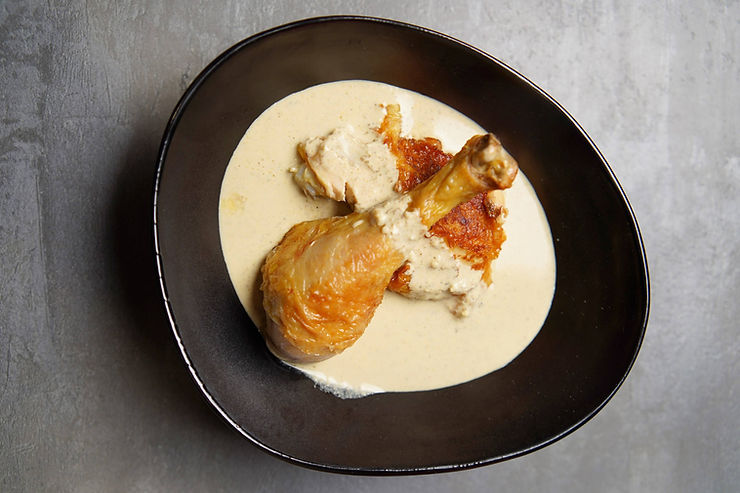
Chicken bazhe does not look like a dish engineered for social media. It is pale, slightly lumpy, unapologetically beige and often served cold. There is no tower, dramatic cheese pull or glossy reduction painted across the plate. Just chicken under a thick walnut sauce, perhaps with a few pomegranate seeds scattered over the top if someone is feeling decorative.
And then you taste it.
Walnuts. Garlic. Coriander. Blue fenugreek. Dried marigold. Vinegar. The richness arrives first, followed by bitterness, perfume and a sharp little slap of acidity that keeps the whole thing from collapsing under its own weight. It tastes creamy, but there is no cream. It feels luxurious, but its foundation is a nut that grew in Georgian yards, orchards and forests.
That is where the history begins.
Walnuts have moved through the Caucasus for thousands of years. Georgia stood along routes connecting Persia, Anatolia, the Black Sea and Central Asia, exactly the kind of place where ingredients, cooking methods and armies all passed through with varying degrees of permission. Georgians did more than adopt the walnut. They made it indispensable.
In much of the world, walnuts are a garnish. In Georgia, they are infrastructure.
Ground walnuts thicken beans, bind vegetables into pkhali, fill fried eggplant, enrich stews, sweeten churchkhela and become sauces for fish, meat and poultry. They provide fat, body and protein without dairy, which made them especially useful during the many Orthodox fasting days when meat and milk disappeared from the table.
Bazhe grew from that world, but there is no surviving document identifying the moment someone first crushed walnuts with garlic and poured them over chicken. It belongs to the less tidy history of household knowledge: grind this finer, add enough water, sharpen it with vinegar, taste it again.
Claims that bazhe came directly from ancient Colchis, Persia or India are difficult to prove. Georgia’s cooking unquestionably reflects centuries of contact with Persian, Ottoman, Arab, Mongol and Russian powers, none of whom were known for passing through quietly. Walnut sauces also appear across the Caucasus, Iran and the former Ottoman world. But bazhe speaks a distinctly Georgian language.
Walnuts provide the weight. Garlic gives it teeth. Coriander adds citrus and warmth. Blue fenugreek, called utskho suneli, brings an earthy, slightly bitter aroma. Dried marigold, often called Imeretian saffron, contributes floral depth and color. Vinegar or pomegranate juice cuts through the walnut oil, while water or broth turns the mixture from paste into sauce.
The method appears simple, but walnuts are temperamental. Grind them too coarsely and the sauce feels gritty. Overwork them and they become oily and heavy. Add too much water and you have expensive beige soup. Traditionally, the nuts were pounded until they released their oil, then worked together with garlic, spices and acidity. This is not effortless rustic cooking. It is skilled labor wearing ordinary clothes.
Chicken makes sense beside bazhe because it does not compete. Roasted or boiled, the mild meat gives the sauce somewhere to land. Bazhe is generally uncooked, preserving the raw richness of the walnuts and the direct force of the garlic and spices.
This is also where bazhe is confused with satsivi.
Both contain walnuts, garlic, spices and acidity. Both can accompany poultry and may be served cold. But bazhe is fundamentally a versatile, uncooked sauce, served with chicken, fish, vegetables or ghomi. Satsivi is usually a more elaborate dish in which chicken or turkey is combined with a cooked walnut sauce enriched with poultry broth. It is strongly associated with Christmas and New Year in Georgia. Bazhe can appear without ceremony. Satsivi arrives carrying the emotional weight of a holiday.
Calling every Georgian chicken-and-walnut dish satsivi is like calling every French beef stew boeuf bourguignon. You will survive the error, but somebody’s grandmother may decide you cannot be trusted.
Walnut-heavy cooking is particularly associated with western Georgia, including Imereti, Samegrelo, Guria and Adjara, although bazhe is now made across the country. Every household has an opinion. Some make it nearly as thick as hummus. Others prefer it closer to gravy. Some insist on vinegar; others use pomegranate juice. Some toast the walnuts, while traditionalists favor them raw.
This is how old food survives. Not by remaining frozen, but by generating arguments.
Chicken bazhe also fits naturally into the supra, Georgia’s ritualized feast of food, wine, hospitality and carefully ordered toasts. At a supra, abundance matters. Plates multiply, bread disappears under herbs, cheese, vegetables and meat, and guests are encouraged to eat as though refusal might cause a minor diplomatic incident.
'
Bazhe performs abundance exceptionally well. A pile of walnuts becomes a bowl of rich sauce. An ordinary chicken becomes a platter worthy of company. Bread dragged through what remains ensures that nothing valuable is wasted.
That is the contradiction at the heart of the dish. Chicken bazhe tastes extravagant, yet its logic is rooted in economy. It contains no cream, butter or elaborate imported luxury. It can grace a feast, but its wisdom is domestic: use what grows, grind it carefully, season it boldly and make enough for everyone.
Done properly, the sauce has tension. The walnuts are rich but not dull. The vinegar is sharp but not sour. The garlic is forceful without becoming punishment. Blue fenugreek and marigold linger in the background, making the dish taste unmistakably Georgian even if you cannot explain exactly why.
Chicken bazhe survived not because a monarch demanded it or a famous chef codified it. It survived because walnuts grew there, families knew what to do with them and the sauce could transform poultry, fish, vegetables and bread. It satisfied religious fasting traditions without tasting like deprivation and turned an everyday chicken into something worthy of a feast.
A chicken. A pile of walnuts. Garlic, coriander, blue fenugreek, marigold, vinegar and water.
No dairy. No culinary acrobatics. No garnish pleading for applause.
Just Georgia, ground fine enough to become a sauce.
Chicken Bazhe Recipe
Prep time 20 minutes | Cook time 1-1.5 hour | Serves 4
Ingredients
For the chicken:
1 whole chicken, about 3½–4 pounds
1½ teaspoons salt
½ teaspoon black pepper
1 tablespoon neutral oil
For the bazhe:
2 cups raw walnuts
2–3 garlic cloves, roughly chopped
1½ teaspoons ground coriander
2 teaspoons ground blue fenugreek
2 teaspoons ground dried marigold petals, also called Imeretian saffron
1-2 teaspoons salt, plus more to taste
2 tablespoons white wine vinegar
1–1½ cups warm water or unsalted chicken broth
To serve:
Pomegranate seeds
Chopped cilantro or parsley, optional
Georgian bread or another crusty bread
Instructions
Heat the oven to 400°F.
Pat the chicken dry and season it inside and out with salt and black pepper. Rub the skin lightly with oil.
Place the chicken in a roasting pan and roast for 55–70 minutes, until the skin is golden and the thickest part of the thigh reaches 165°F. Rest for 15 minutes, then cut into serving pieces.
While the chicken roasts, grind the walnuts in a food processor until very fine. Stop before they turn completely into walnut butter.
Add the garlic, coriander, blue fenugreek, marigold, cayenne and salt. Process again until evenly combined.
With the processor running, gradually add the vinegar and 1 cup of warm water or broth. Continue blending until the sauce is smooth, creamy and pourable. Add more liquid as needed. The bazhe should coat a spoon but still flow easily.
Taste and adjust the balance. Add more salt for depth, vinegar for sharpness or pomegranate juice for a fruitier acidity. Let the sauce rest for at least 30 minutes so the flavors can develop.
Arrange the chicken on a serving platter and spoon the bazhe generously over it. Serve at room temperature or chilled, garnished with pomegranate seeds and herbs if desired.
Bazhe thickens as it rests, so stir in a little water or broth before serving if necessary. Do not boil the sauce; excessive heat can make the walnuts separate and turn oily.


Comments