About
Working as a tutor for international students all through college taught me two truths that shaped the way I see the world.
First: cultures are wildly, beautifully different — and the more you lean into those differences, the more you learn.
Second: if you want to make a real connection with someone, start with food.
The job was rewarding, and yes, it paid the bills, but what I didn’t expect was how much they would teach me. Every student brought with them a world I had never stepped foot in — stories, memories, flavors — and I had front-row access. I was teaching grammar and idioms, but they were teaching me the unspoken language of their homelands. And more often than not, that language began with a dish.
In every first meeting of the term, I’d ask the same question: “What was your favorite dish your mother made when you were growing up?” It was an easy icebreaker, but it was also a window — a way to see what mattered to them, what tasted like home.
With my Saudi students, something incredible happened. No matter the region, no matter the city, the answer was always the same:
Kunefe.
At first, I had no idea what it was. Their descriptions left me more confused each time.
“It’s like a Middle Eastern cheesecake.”
“It’s sweet and stringy, like pizza…but not.”
“It has thin dough…on top…and cheese…but not that kind of cheese.”
What did that even mean? My mind conjured up grotesque hybrids of cheesecake and filo dough, bizarre sweet-savory monsters that couldn’t possibly exist. But each student’s eyes lit up the same way when they said the word.
Kunefe.
Whatever it was, it clearly mattered.
I knew that the moment I had a proper kitchen, I would attempt this mysterious, beloved dish. And when I finally did, the process was simpler than the mythology around it. Kadayifi dough — hair-thin strands of pastry — packed around a layer of sweet, stretchy sheep’s cheese, crisped in butter, then drenched in a fragrant syrup kissed with citrus. The challenge wasn’t the method; it was the balance. Too much syrup and it’s soggy. Too little and it’s dry. The cheese must be molten, the exterior shatteringly crisp.
My first attempt? Surprisingly successful.
But satisfaction didn’t follow. How could it? How do you recreate a flavor you’ve never tasted? It felt like painting a tree without ever seeing one — a blind artist stumbling through a cheesy dreamscape.
I knew I needed to find the real thing.
A year and a half passed before fate led me to the Tel Aviv shuk. The moment I stepped into the chaos of that market — the shouting vendors, the smell of spices, the crush of people — something pulled me forward. Instinct guided me through the maze until I found a stall piled high with Mediterranean pastries.
And there it was.
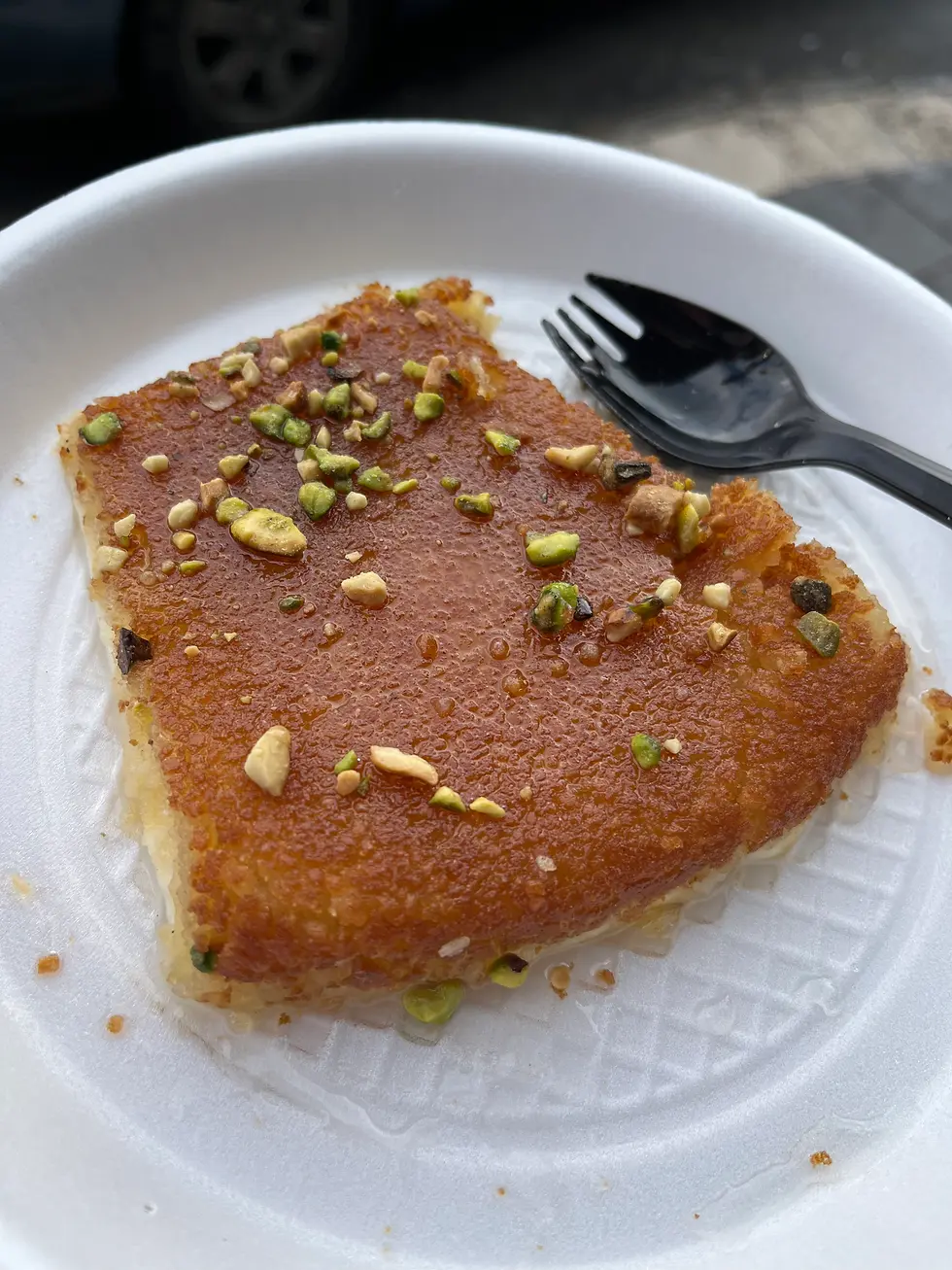
Kanafe, glowing like a golden sun on a massive steel tray, nearly fifty slices deep. My slice cost me two dollars. It tasted like the end of a pilgrimage.
Creamy. Crispy. Salty. Sweet. A perfect collision of textures and flavors, everything in balance, nothing out of place. My two-year quest ended right there, standing in the middle of the shuk with syrup dripping down my fingers.
But journeys evolve.
Edit, 2023: By now, I’ve tasted kanafe in Israel, Turkey, the UAE — each one wonderful, each one different. But none come close to the slice I found in a small corner shop in downtown Amman, Jordan. Dense, sweet, rich — a holy kiss from the Levant. And now the mission is mine: to recreate that kanafe, the one that tasted like the Middle East finally speaking back to me.
The adventure continues.

.jpg)
INGREDIENTS
For the syrup:
1 cup sugar
1/2 cup water
1 teaspoon lemon juice
2 tablespoons honey
1 teaspoon orange blossom water or rose water (optional)
For the knafeh layers:
1 pound kadayif dough (shredded, available in Middle Eastern grocery stores)
1 cup unsalted butter, melted
For the cheese filling:
2 cups ricotta cheese or akkawi cheese, crumbled
1 cup of Jordanian cream cheese, can use regular cream cheese loosened in a bit of condensed milk
1/2 cup finely chopped pistachios or a mix of pistachios and almonds

Small Book Big Flavor Vol. 1 is your essential guide to transforming everyday meals into culinary delights with minimal effort. This compact book reignites the joy of home cooking by offering easy-to-follow recipes and practical tips that infuse bold flavors into your dishes. Whether you're a beginner or an experienced cook, you'll find inspiration in its diverse, globally-influenced ideas, from creamy chicken curry to flavorful pilaf rice. Embrace the art of soulful, memorable home cooking and make every meal an event with this indispensable culinary resource.
Instructions
Kunefe, Kanafe, Middle Eastern Cheese Cake; Whatever you call it, it is dessert perfection.
Click here for video recipe and story on Instagram
Prepare the Syrup:
In a saucepan, combine sugar and water. Bring to a boil, then reduce heat and let it simmer for about 10 minutes until it slightly thickens.
Remove from heat and stir in lemon juice and orange blossom water or rose water if using. Set aside to cool.
Prepare the Cheese Filling:
If using akkawi cheese, soak it in water for a couple of hours, changing the water several times to remove excess saltiness. Then, crumble the cheese into a bowl.
Prepare the Knafeh Layers:
Preheat your oven according to the package instructions on the knafeh dough.
Untangle the knafeh dough and cut it into short strands, you can do this by tearing it with your hands. Place it in a large bowl and pour the melted butter over it. Mix well, making sure the strands are coated with butter.
Assemble and Bake:
Grease a round baking pan or a large baking dish with butter.
Spread half of the buttered knafeh dough evenly on the bottom of the pan, pressing down gently to create a compact layer.
Evenly spread the cheese ad then the cream cheese mixture over the knafeh layer.
Cover the cheese filling with the remaining knafeh dough, pressing it down gently.
Drizzle a little extra butter over the top.
Bake in the preheated oven according to the package instructions on the knafeh dough, or until the top is golden and crispy.
Syrup and Serving:
Once the knafeh is done baking, remove it from the oven and immediately pour the cooled syrup evenly over the hot knafeh. This helps the syrup soak into the dessert.
Sprinkle the chopped nuts over the top.
Cool and Serve:
Allow the knafeh to cool for a bit before slicing and serving. This allows the flavors to meld together.
Knafeh is traditionally served warm. Enjoy!


